You’re ready to take your bench grinder from basic to brilliant, and the right deburring wheel makes all the difference. These tools strip rust, smooth edges, and polish metal like magic, saving you time and frustration. But not all wheels perform the same, so picking the perfect grit, size, and material matters more than you think.
More Details on Our Top Picks
3PCS 4″ Bench Grinder Polishing Wheels (320/600/800 Grit)
[zw asin=”B0DBLJFFCS” alt=”3PCS 4 Bench Grinder Polishing Wheels (320/600/800 Grit)”]Best Value
View Latest PriceFor budget conscious DIYers who need solid deburring power without overspending, this 3 pack delivers real value. You’re getting three 4-inch wheels (100mm across, about 1.2 inches thick) with a 13mm bore, so check your spindle fits. The 320 grit red tackles heavy oxide and rust first. Then you switch to 600 green for smoothing burrs, and finish with 800 gray to restore that original metal gleam. They’re nonwoven nylon, so they resist wearing down and won’t gouge softer surfaces like aluminum or wood. You’ll hear less chatter too. A 90-day replacement policy backs them, which is rare at this price.
- Diameter:4 inches
- Arbor Hole Size:13mm (~0.51 inches)
- Thickness:1.2 inches
- Grit Level:320# (red), 600# (green), 800# (gray) – coarse/medium/fine
- Hardness Rating:Not specified
- Maximum RPM:Not specified (fits bench grinders)
- Additional Feature:Nonwoven fabric construction
- Additional Feature:3-pack with varied grits
- Additional Feature:Protects against over-cutting
6″ Bench Grinder Polishing Wheels 9P Hardness Nylon Fiber Deburring Wheel
[zw asin=”B0C3CVND9D” alt=”6 Bench Grinder Polishing Wheels 9P Hardness Nylon Fiber Deburring Wheel”]Most Versatile
View Latest PriceThis 6-inch wheel turns your bench grinder into a polishing powerhouse. You’ll tackle deburring, removing burrs, sharp edges, paints, oxides, welding stains, and scratches on ceramics, marble, metal, plastic, and wood. Its nylon fiber and silicon carbide construction won’t leave adhesive residue, so your workpieces stay clean without black or yellow discoloration. The web design resists clogging and dissipates heat well, keeping noise low. You’ll get smooth operation with a 180 grit hardness. Just keep it under 3000 RPM for best results. It’s a durable, high-speed performer for your shop.
- Diameter:6 inches
- Arbor Hole Size:1/2 inch
- Thickness:1 inch
- Grit Level:180 grit (medium)
- Hardness Rating:9P
- Maximum RPM:3000 RPM
- Additional Feature:Web design construction
- Additional Feature:Water and oil resistant
- Additional Feature:No adhesive residue left
6 inch 180 Grit Nylon Deburring Wheel (3-Pack)
[zw asin=”B0C6ZP5F5F” alt=”6 inch 180 Grit Nylon Deburring Wheel (3-Pack)”]Best Multipack
View Latest PriceYou’re hunting for a deburring wheel that keeps working long after sandpaper gives up, and the 6-inch, 180-grit nylon option stands out as the top multipack choice for anyone outfitting a bench grinder. With a 1-inch thickness and a 1/2-inch arbor hole, these wheels fit most standard grinders. They tackle welding stains, edge burrs, and scratches on everything from kitchen utensils to golf clubs.
Here’s what makes them shine:
- Durable construction: High-grade silicon carbide bonded to nylon fiber resists heat and wear.
- Safe speeds: Keep your grinder between 1800 and 2800 RPM. Exceeding 3500 risks wheel rupture.
- Versatile use: Add lubricant for a finer finish, or run them dry for aggressive deburring.
You get three wheels per pack, so you’re set for heavy sessions without constant replacements.
- Diameter:6 inches
- Arbor Hole Size:1/2 inch
- Thickness:1 inch
- Grit Level:180 grit (medium)
- Hardness Rating:9P
- Maximum RPM:2800 RPM (max 3500)
- Additional Feature:3-pack included
- Additional Feature:Works with lubricants
- Additional Feature:Alternative to sandpaper
Deburring Nylon Fiber Buffing Wheel 9P Hardness. Polishing Stainless Steel
[zw asin=”B09PMVBJN3″ alt=”Deburring Nylon Fiber Buffing Wheel 9P Hardness. Polishing Stainless Steel”]Best For Medium Duty
View Latest PriceIf you need a wheel that handles both metal and non-metal surfaces without overheating, the AmaCupid 8 inch nylon fiber wheel is a solid pick for medium duty work. Its 9P hardness and 180 mesh grit strike a perfect balance for removing burrs, welding stains, and scratches from stainless steel, ceramics, or wood. You won’t see discoloration or marks, thanks to its heat dissipating mesh fiber. Run it between 1800 and 2800 rpm, and don’t exceed 3500 rpm. Use lubricant for a finer finish, and you’ll polish everything from golf clubs to kitchen utensils.
- Diameter:8 inches
- Arbor Hole Size:5/8 inch
- Thickness:1 inch
- Grit Level:180 grit (medium)
- Hardness Rating:9P
- Maximum RPM:2800 RPM (max 3500)
- Additional Feature:Wet/oil/dry operation
- Additional Feature:Intermediate polish stage
- Additional Feature:Reduces dust during use
8″ Deburring Wheel Nylon Fiber Polishing Wheels 9P
[zw asin=”B0BDKS4CJS” alt=”8 Deburring Wheel Nylon Fiber Polishing Wheels 9P”]Top Rated
View Latest PriceGytycatah’s 8″ deburring wheel makes a top rated pick for metalworkers and hobbyists tackling stainless steel, stone, or ceramics. You get a premium nylon fiber mesh with silicon carbide grit at 180, striking a sweet spot for medium deburring without overgrinding. The 9P hardness (harder than 7P) bites efficiently, while the 5/8″ arbor lets it fit most bench grinders. It runs up to 3000 rpm, so you can polish glass, marble, or wood furniture too. Easy to swap, built to last, this wheel simplifies your workshop flow.
- Diameter:8 inches
- Arbor Hole Size:5/8 inch
- Thickness:1 inch
- Grit Level:180 grit (medium)
- Hardness Rating:9P (harder than 7P)
- Maximum RPM:3000 RPM
- Additional Feature:Easy installation/removal
- Additional Feature:Wear-resistant construction
- Additional Feature:Premium mesh fiber structure
6″ Deburring Wheel Nylon Fiber Polishing Wheels 9P
[zw asin=”B0BDKM91CP” alt=”6 Deburring Wheel Nylon Fiber Polishing Wheels 9P”]Most Popular
View Latest PriceThe 6″ deburring wheel is the most popular choice for DIYers and pros tackling mixed materials. You’ll grab this nylon fiber wheel for stainless steel, wood, glass, even ceramics, and it won’t scorch or discolor your workpiece thanks to that mesh structure’s heat dissipation.
At 6 inches wide and 1 inch thick, with a 5/8-inch arbor hole, it fits most bench grinders up to 3000 rpm. You get a 180-grit, medium polish that’s harder than a 7P rating, so it’s tough but forgiving. And at just an ounce, installation’s a breeze.
You’ll appreciate the wear resistance from high-toughness nylon, meaning it lasts through multiple projects. One wheel per pack, straightforward performance, and a solid 4.4-star average from 35 users. Perfect for a quick edge cleanup or a smooth finish on varied materials.
- Diameter:6 inches
- Arbor Hole Size:5/8 inch
- Thickness:1 inch
- Grit Level:180 grit (medium)
- Hardness Rating:9P (harder than 7P)
- Maximum RPM:3000 RPM
- Additional Feature:Prevents workpiece discoloration
- Additional Feature:Long service life
- Additional Feature:Compatible with bench grinders
Deburring Nylon Fiber Buffing Wheel 9P hardness. Polishing Stainless Steel
[zw asin=”B09PMXCTM5″ alt=”Deburring Nylon Fiber Buffing Wheel 9P hardness. Polishing Stainless Steel”]Professional Grade
View Latest PriceYou’re a metalworker chasing that mirror-like finish on stainless steel? Grab the Deburring Nylon Fiber Buffing Wheel with 9P hardness. It’s your intermediate step between grinding and cloth wheels. This 6-inch, 180 grit wheel uses high-toughness nylon fiber and silicon carbide to tackle welding stains, scratches, and bruises without discoloring your workpiece. The mesh structure dissipates heat and reduces dust, so you work cleaner. Run it between 1800 and 2800 rpm on your bench grinder. For the best surface quality, use a lubricant. It’s a durable, safe alternative to sandpaper or wire wheels.
- Diameter:6 inches
- Arbor Hole Size:1/2 inch
- Thickness:1 inch
- Grit Level:180 grit (medium)
- Hardness Rating:9P
- Maximum RPM:2800 RPM (max 3500)
- Additional Feature:Wet/oil/dry operation
- Additional Feature:Prevents blackening/yellowing
- Additional Feature:Intermediate polish stage
EXL Deburring Wheel 6″ x 1″ x 1″ 9S Fine 05132 1 Pack
[zw asin=”B0BVRRB13W” alt=”EXL Deburring Wheel 6 x 1 x 1 9S Fine 05132 1 Pack”]Best For Fine Finishing
View Latest PriceIf you demand flawless, mirror-like edges on delicate parts, this EXL wheel belongs on your bench. At 6 inches wide with that fine-grade Silicon Carbide, it’s a precision powerhouse. You get 9 density layers, meaning it’s hard enough to last yet conformable to complex curves. No gouging, no heat buildup, just clean deburring. And you can run it wet or dry, up to 6,000 rpm. The telescoping arbor fits 1/2, 5/8, or 3/4 shafts, so your grinder’s ready. Perfect for blending surfaces, removing oxidation, or polishing golf clubs without distorting the metal. It even exceeds ANSI standards.
- Diameter:6 inches
- Arbor Hole Size:1 inch (includes adapter for 1/2, 5/8, 3/4)
- Thickness:1 inch
- Grit Level:9S Fine
- Hardness Rating:9 density
- Maximum RPM:6000 RPM
- Additional Feature:Telescoping arbor adapter
- Additional Feature:Convolute wound construction
- Additional Feature:Wet and dry usage
Cubitron EXL PRO Deburring Wheel – 6″ x 1″ x 1
[zw asin=”B00OXI1KZ4″ alt=”Cubitron EXL PRO Deburring Wheel – 6 x 1 x 1″]Best Durability
View Latest PriceReaching for a deburring wheel that outlasts the pack? The Cubitron EXL PRO gives you 30-50% longer life than its predecessor. That’s not just hype; it’s a serious upgrade. You get silicon carbide abrasive in a 6x1x1 wheel that runs cool, so you won’t discolor or warp heat-sensitive metals. Its non-woven web conforms to contours, removing burrs with minimal pressure, reducing your fatigue. This wheel also resists smearing, keeping cleanup quick. Use it on your bench grinder or die grinder for consistent, fine finishes on metals, composites, even glass. Smooth operation, less rework, higher productivity—period.
- Diameter:6 inches
- Arbor Hole Size:1 inch
- Thickness:1 inch
- Grit Level:180 grit (fine)
- Hardness Rating:Not specified
- Maximum RPM:6000 RPM
- Additional Feature:30-50% longer lifespan
- Additional Feature:Requires less pressure
- Additional Feature:Stays cool during use
4 Pcs 6″ Bench Grinder Polishing Wheel 240/320 Grit Bench Grinder Wheel
[zw asin=”B0DC4C4R7L” alt=”4 Pcs 6 Bench Grinder Polishing Wheel 240/320 Grit Bench Grinder Wheel”]Best For Restoration
View Latest PriceThe 4-pack 6″ bench grinder polishing wheel set shines brightest for restoration work. You get two 240 grit and two super fine 320 grit wheels, perfect for tackling rust spots, scratches, and oxide layers on metals like stainless steel, aluminum, and copper. These non-woven wheels prevent over-cutting and minimize scratching, so you won’t ruin your workpiece. Their open mesh structure dissipates heat efficiently, reducing discoloration and deformation. Each wheel measures 6 inches by 1 inch, fits a 20mm arbor, and handles up to 3000 rpm. You’ll achieve a smooth satin finish without the guesswork.
- Diameter:6 inches
- Arbor Hole Size:20mm (~0.79 inches)
- Thickness:1 inch
- Grit Level:240 grit and 320 grit
- Hardness Rating:Not specified
- Maximum RPM:3000 RPM
- Additional Feature:4-pack included
- Additional Feature:Open mesh structure
- Additional Feature:Round and true side-to-side
Factors to Consider When Choosing a Deburring Wheel for Bench Grinder
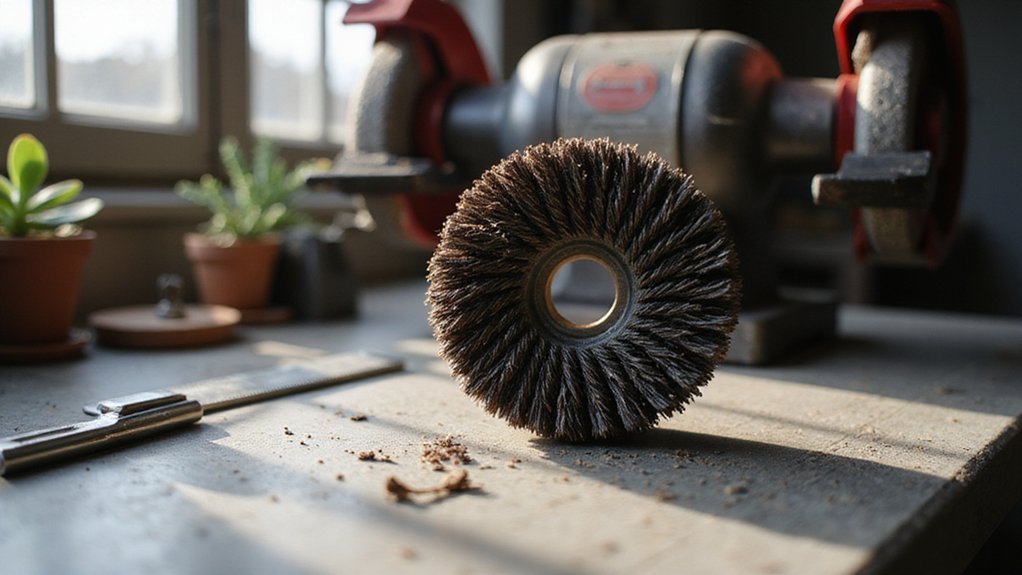
When you’re picking a deburring wheel for your bench grinder, you’ve got five key factors to weigh: wheel size and arbor compatibility, grit and material type, hardness and density, heat and RPM limits, and what you’ll actually be deburring most often. Start with fit, since a wheel that doesn’t match your grinder’s arbor size or maximum speed is a nonstarter, and then match the grit to your workpiece’s material, like using finer grits for softer metals to avoid gouging. Hardness and density dictate how aggressively the wheel cuts versus how smoothly it finishes, so you’ll want to balance that against the heat generated at high RPMs to prevent warping your parts—and remember, a versatile medium-hard wheel handles most jobs without needing a swap.
Wheel Size & Arbor
Let’s kick things off by sizing it up right. You’ve got to match the wheel diameter to your bench grinder’s size, or you’re asking for trouble. A wheel that’s too small won’t cover your workpiece properly, while an oversized one can spin dangerously or hit the guards. Safety first, right?
Now, don’t overlook the arbor hole. That hole must fit your grinder’s spindle snugly, no wobbling or slipping allowed. If it’s off, you risk damaging both the wheel and your machine. And here’s a pro tip: a larger wheel gives you more surface area, so you can deburr bigger pieces faster. But for tight spots, a smaller wheel is your friend.
Grit & Material Type
Two main factors decide how your deburring wheel performs: grit level and material type. Coarser grits, like 180, rip through material fast, perfect for heavy burrs. Finer grits, such as 800, give you a smooth, polished finish. For most jobs, medium grit around 180 strikes the right balance between speed and smoothness.
Now, material type matters just as much. Silicon carbide abrasives are harder and sharper, so they excel on tough surfaces like ceramics or stone. Aluminum oxide, on the other hand, works better on softer metals, offering more control. The material also affects heat resistance and wear rate. You don’t want discoloration on your workpiece, so choose wisely. Pair the right grit with the right abrasive, and you’ll get clean results every time.
Hardness & Density
Hardness and density work together to determine how a deburring wheel actually cuts and feels on your bench grinder. Hardness, often rated with a P scale (like 6P or 9P), tells you how much material the wheel can remove. Higher hardness levels, like 9P, are perfect for aggressive deburring on tough metals. Lower hardness wheels are better for delicate surfaces.
Density matters just as much. Dense wheels pack abrasive particles tightly, giving you more aggressive removal but also more heat, so you’ll need to watch your speed. Less dense wheels run cooler and polish rather than tear.
Here’s a quick rule of thumb:
- Hard & Dense: Long lasting, great for heavy stock removal on steel.
- Soft & Open: Excellent for finishing aluminum or soft alloys without gouging.
Match your wheel’s hardness and density to your workpiece. You’ll avoid damaging your project and get cleaner results faster.
Heat & RPM Limits
And while hardness and density shape how a wheel cuts, heat and RPM limits define the safe operating window you can’t ignore. Always verify the manufacturer’s maximum RPM rating; exceeding it risks wheel failure. Higher speeds generate more heat, which can warp or melt the abrasive, ruining performance and creating hazards. Use a variable speed grinder to dial in the right RPM and keep temperatures down.
You’ll want a wheel with good heat dissipation features for tougher jobs. Regularly inspect for discoloration or warping; these are signs you’ve pushed it too far. Replace any damaged wheel immediately. Here are key steps:
- Check the RPM limit before mounting.
- Start at a lower speed, then increase gradually.
- Watch for overheating during long runs.
That’s your safe zone. Respect it.
Application Suitability
Since your bench grinder’s speed and heat limits are locked in, the next big move is picking a wheel that actually fits your material and task at hand. You’ll need to match the wheel’s abrasive type and grit size to your workpiece. For stainless steel or ceramic, opt for a non-loading, fine grit wheel. Harder wheels deliver precise deburring, while softer ones excel at polishing.
And don’t forget the basics: check the wheel’s size and arbor hole match your grinder. A loose fit is a safety hazard. Also, verify the maximum operating speed on the wheel’s label. Over speeding it risks failure. Finally, choose a wheel built for heat resistance, so it won’t degrade during continuous, high speed use. That’s how you get clean results without guesswork!
Build & Wear Life
Once you’ve sorted out which abrasive matches your material, it’s time to think about how long that wheel will keep earning its spot on your grinder. You want a deburring wheel built to last, so check for high-quality materials like silicon carbide or nylon fibers. Those offer serious wear resistance. The construction matters too. Convolute winding or a mesh fiber structure adds durability, handling continuous use without breaking down.
Grit size also affects life. A medium 180 grit wheel tends to outlast finer options while staying effective. Don’t ignore the maximum rated speed. Match it to your grinder’s RPM to avoid premature wear or a dangerous failure. Finally, inspect your wheel regularly for thinning, cracks, or excessive wear. These signs keep you safe and your results consistent. With the right build, you’ll get long, reliable performance.
Tool Compatibility
Before you lock in a deburring wheel, you’ve got to make sure it’ll actually fit your bench grinder. First, match the arbor hole to your spindle diameter, or you’ll wrestle with wobble. Check the wheel’s max RPM against your grinder’s speed; exceeding it invites disaster, so don’t skip that number. Size matters too: a fat wheel crowds tight angles, while a thin one struggles on broad surfaces.
Now, think about your process. Is the wheel rated for dry, water, or oil? Using the wrong mode ruins both it and your workpiece. And match the abrasive material to your job: metal needs grit teeth, ceramic demands toughness, and wood calls for softer flex. Get these four checks right, and you’re set. Get one wrong, and you’ll know immediately.