If you’ve ever had a lead fail mid weld, you know the frustration of chasing an arc that just won’t hold. You don’t need that distraction, you need gear that keeps you focused on your bead. And, with stick welding, your leads are the literal lifeline between you and the metal, so choosing the wrong ones can ruin your day faster than a stuck rod. This list cuts through the noise to give you ten reliable options built for real work, not just shelf appeal.
More Details on Our Top Picks
SÜA 150 Amp Welding Electrode Holder Lead Assembly (15 Feet)
[zw asin=”B07D3ZQ3CP” alt=”SÜA 150 Amp Welding Electrode Holder Lead Assembly (15 Feet)”]Best for Short Runs
View Latest PriceIf you’re working on quick repairs or tight jobs, this 15 foot lead keeps you nimble without excess cable getting in your way. It’s built with a made in USA Flex-A-Prene cable, 100% copper, so you get solid conductivity. The heavy duty nylon body and high conductivity jaws grip electrodes up to 1/4 inch securely, thanks to a high strength coiled spring. Rated for 150 amps at 60% duty cycle, it works with Dinse 10 25 connectors. You can swap it in without tools, no fuss. Perfect for outdoor or indoor stick welding.
- Cable Gauge (AWG):Not specified (copper cable, 150A rated)
- Cable Length:15 feet
- Maximum Amp Rating:150 amps
- Connector Type:Dinse 10-25 (male-to-male)
- Max Voltage Rating:600 volts
- Weight:3.1 pounds
- Additional Feature:Made-in-USA Flex-A-Prene cable
- Additional Feature:High-strength coiled spring
- Additional Feature:Supports electrodes up to 1/4 inch
SSimder Welding Stinger 600A Ergonomic Electrode Holder
[zw asin=”B0DGG9NMW6″ alt=”SSimder Welding Stinger 600A Ergonomic Electrode Holder”]Ergonomic Design
View Latest PriceYou get effortless rod changes with this 600A stinger, thanks to its ergonomic design that needs just one finger to lock in electrodes. That single press cuts required strength by 300%, so your hand won’t cramp during long sessions. The self-locking copper jaw grips rods firmly, even overhead or vertical, meaning less slippage and fewer re-adjustments.
You’ll also appreciate three adjustable angles—90°, 135°, and 170°—so you adapt to flat, horizontal, or vertical work without shifting your stance. Built from heavy-duty copper with heat-resistant handles and arc-resistant insulation, it handles high amperage without overheating. It connects to standard DINSE 10-25 or 35-50 plugs, fitting most stick welders. Weighing just 1.1 pounds, it’s manageable, and the 2-year warranty backs your investment.
- Cable Gauge (AWG):Not specified (electrode holder only, no cable)
- Cable Length:Not applicable (electrode holder only)
- Maximum Amp Rating:600 amps
- Connector Type:Dinse 10-25 and 35-50 (compatible)
- Max Voltage Rating:Not specified
- Weight:1.1 pounds
- Additional Feature:Single-finger rod installation
- Additional Feature:Self-locking copper jaw
- Additional Feature:Three adjustable welding angles
WeldingCity 1-AWG Heavy Duty Welding Cable Kit
[zw asin=”B07QNRSSBG” alt=”WeldingCity 1-AWG Heavy Duty Welding Cable Kit”]Heavy-Duty Kit
View Latest PriceThe WeldingCity 1-AWG Heavy Duty Welding Cable Kit is your best bet if you need a rugged, all in one setup that can handle tough job sites. You’re getting USA-made 1-AWG cable with an EPDM rubber jacket that shrugs off cuts, oils, acids, and even direct sunlight. It’s rated for 600V and works from -50°C to 105°C, so extreme conditions won’t slow you down.
You can choose Tweco-type or Dinse-type connectors, both with heat and oil resistant covers. The kit includes a 300-amp electrode holder with copper brass jaws, plus an accessory kit. It weighs just 4.38 pounds and arrives ready to go. Just pick your connector, hook it up, and start welding.
- Cable Gauge (AWG):1-AWG
- Cable Length:Not specified
- Maximum Amp Rating:Not specified (300A electrode holder included)
- Connector Type:Tweco-type or Dinse-type twist-lock
- Max Voltage Rating:600V
- Weight:4.38 pounds
- Additional Feature:Orange rubber jacket
- Additional Feature:EPDM rubber insulation
- Additional Feature:300-amp stick electrode holder included
SÜA Ultra Flex 200A Welding Electrode Holder Assembly
[zw asin=”B0FWYQPJ2Q” alt=”SÜA Ultra Flex 200A Welding Electrode Holder Assembly”]Ultra-Flexible Choice
View Latest PriceNeed a lead that won’t fight you in tight corners, on scaffolding, or along a pipeline? The SÜA Ultra Flex 200A Assembly is your answer. It uses premium Ultra-Flex Class M #2 AWG cable with fine-stranded 34 AWG copper conductors, so you get maximum flexibility and efficient current transfer. Rated for 200 amps at 60% duty cycle, it’s built for shipyards and cramped industrial spaces. The heavy-duty nylon holder features copper alloy jaws and a reinforced coiled spring for a firm grip on electrodes up to ¼ inch. Plus, it’s assembled in the USA to your specs, with multiple connector options. No tools needed. You’ll stay nimble and productive.
- Cable Gauge (AWG):#2 AWG
- Cable Length:15 feet (standard, multiple options available)
- Maximum Amp Rating:200 amps
- Connector Type:LC-40 Cam-Lock, Dinse 10-25, Dinse 35-70, or Terminal Lug
- Max Voltage Rating:Not specified
- Weight:5.4 pounds
- Additional Feature:Ultra-Flex Class M #2 AWG
- Additional Feature:TPE jacket resists battery acid
- Additional Feature:Assembled in USA same day
WeldingCity 25-Ft 2-AWG Welding Cable with Stinger & Dinse Plug
[zw asin=”B07GVR1RBX” alt=”WeldingCity 25-Ft 2-AWG Welding Cable with Stinger & Dinse Plug”]Versatile Setup
View Latest PriceFor stick welding beginners and pros who value a versatile setup, this lead pairs heavy duty performance with easy swapping between tools. You get a 25-foot, 2-AWG cable made in the USA with a rugged EPDM rubber jacket. It resists cuts, tears, chemicals, and extreme temps from -50°C to 105°C. The Dinse-type twist-lock connector lets you switch from stinger to work clamp in seconds. Your setup includes:
- 300-amp stinger with strong copper jaws
- Heat and oil resistant covers
- Copper splice cap for secure connections
Grab this lead for reliable, flexible power on any job site.
- Cable Gauge (AWG):2-AWG
- Cable Length:25 feet
- Maximum Amp Rating:Not specified (300A electrode holder included)
- Connector Type:Dinse-type twist-lock male connector
- Max Voltage Rating:600V
- Weight:7.81 pounds
- Additional Feature:Black EPDM rubber jacket
- Additional Feature:Includes work clamp set option
- Additional Feature:Resistant to chemicals and oils
WeldingCity Heavy Duty Welding Cable 10-ft 2-AWG
[zw asin=”B07GVRZFMC” alt=”WeldingCity Heavy Duty Welding Cable 10-ft 2-AWG”]Compact Option
View Latest PriceWeldingCity’s 10-foot, 2-AWG lead packs serious punch into a surprisingly compact option, making it your best bet if you’re a mobile welder or weekend fabricator who hates wrestling with bulky, stiff cables. Constructed with USA-made EPDM rubber, this cable laughs at cuts, chemicals, and the harshest weather. You can work confidently from -50°C to 105°C, and its 600V rating handles your toughest jobs without complaint.
The Dinse-type twist-lock connector secures with a satisfying click, accepting AWG #2 to 1/0 gauges. The 1/2-inch pin and heat-resistant cover mean no fuss, no arcing.
Choose from three setups:
- Cable only for your own connectors.
- Stick holder set with a 300-amp, heavy-duty jaw.
- Work clamp set with a zinc-plated, copper-jawed clamp.
Keep it simple. Keep it reliable. This is your lead.
- Cable Gauge (AWG):2-AWG
- Cable Length:10 feet
- Maximum Amp Rating:Not specified (300A electrode holder included)
- Connector Type:Dinse-type twist-lock male connector
- Max Voltage Rating:600V
- Weight:4.19 pounds
- Additional Feature:Copper braid for reliable contact
- Additional Feature:300-amp USA-made electrode holder
- Additional Feature:Zinc-plated steel work clamp
WeldingCity 2-AWG Heavy Duty Welding Cable 50-ft
[zw asin=”B07GVSYT1Q” alt=”WeldingCity 2-AWG Heavy Duty Welding Cable 50-ft”]Long-Reach Workhorse
View Latest PriceIf you need a long-reach workhorse for heavy duty jobs, the WeldingCity 2-AWG Heavy Duty Welding Cable 50-ft is your best bet. This USA made cable uses EPDM rubber jacketing, so it stays flexible in weather from -50°C to 105°C while resisting cuts, oils, and chemicals. You can pair it with your existing gear or grab a complete set. Choose between:
- A 300-amp stick electrode holder with copper jaws and a Dinse connector
- A work clamp set featuring a zinc-plated steel ground clamp with copper clad jaws
Both options include a twist lock Dinse plug that accepts cables from #2 to 1/0 AWG. At 14.19 pounds, this 50 footer delivers serious reach without weighing you down.
- Cable Gauge (AWG):2-AWG
- Cable Length:50 feet
- Maximum Amp Rating:Not specified (300A electrode holder included)
- Connector Type:Dinse-type twist-lock male connector
- Max Voltage Rating:600V
- Weight:14.19 pounds
- Additional Feature:Copper-clad ground clamp jaws
- Additional Feature:Copper-plated hex screw
- Additional Feature:Large contact area grounding
SÜA 200 Amp Welding Electrode Holder Lead Assembly
[zw asin=”B07D3Z6SHF” alt=”SÜA 200 Amp Welding Electrode Holder Lead Assembly”]Best Mid-Range
View Latest PriceYou need a mid range welding lead that balances cost, performance, and build quality without stepping up to pro level prices. The SÜA 200 Amp assembly hits that sweet spot with a Flex-A-Prene cable, #2 AWG copper, and a heavy-duty nylon body. It handles up to 1/4 inch electrodes and runs at 200 amps with a 60% duty cycle, so you can trust it for outdoor jobs. Choose your connector: Dinse 10-25, LC-40 Cam-Lock, Dinse 35-70, or terminal lug. Just match it to your welder’s receptacle. And note, it’s assembled to order, so you get it fresh, ready to work.
- Cable Gauge (AWG):#2 AWG
- Cable Length:15 feet (customizable)
- Maximum Amp Rating:200 amps
- Connector Type:Dinse 10-25, LC-40, Dinse 35-70, or Terminal Lug
- Max Voltage Rating:600 volts
- Weight:Not specified
- Additional Feature:Male-to-male heat-resistant connector
- Additional Feature:Assembled to order same day
- Additional Feature:Meets SAE standards
WeldingCity USA-Made 2-AWG Welding Cable with Electrode Holder
[zw asin=”B085KCTJRF” alt=”WeldingCity USA-Made 2-AWG Welding Cable with Electrode Holder”]Orange Jacket Durability
View Latest PriceThis cable is built for welders who demand long lasting reliability. You’re getting a 10 foot, 2-AWG copper lead wrapped in an EPDM jacket. That orange insulation handles cuts, tears, oil, and even ozone. It also shrugs off weather and sunlight. Temperature range? From minus 50°C up to 105°C, so it works in your shop or outdoors. Max voltage is 600V. You can choose the cable only, or pair it with a Tweco or Dinse twist lock male connector. The included 300 amp stick holder has copper jaws and an ergonomic grip. It feels balanced. No fuss, just tough performance.
- Cable Gauge (AWG):2-AWG
- Cable Length:10 feet
- Maximum Amp Rating:Not specified (300A electrode holder included)
- Connector Type:Tweco-type or Dinse-type twist-lock male connector
- Max Voltage Rating:600V
- Weight:4.19 pounds
- Additional Feature:Orange insulation cover
- Additional Feature:Tweco-type twistlock connector option
- Additional Feature:Ball-point screw connector design
CT-40FA Welding Terminals & LC-40 Male Cable Connectors 2Set
[zw asin=”B0FZB7NC6W” alt=”CT-40FA Welding Terminals & LC-40 Male Cable Connectors 2Set”]Connector Accessory Set
View Latest PriceEvery welder needs a reliable connector accessory set for secure, high-current connections. The CT-40FA terminals and LC-40 male connectors deliver exactly that, with a face-to-face contact design that slashes resistance and keeps your arc steady. You get two of each in a pack, handling cables from 1/0 to 2/0 (50-70mm²) and up to 350 amps. That 45° angle on the LC-40? It’s a lifesaver in tight spots. Plus, these are precision machined from brass extrusion, with thick covers that laugh off heat and sparks. Black and red options help you keep polarity straight. Rated 4.8 out of 5 stars, it’s a smart buy for stick, MIG, or TIG work.
- Cable Gauge (AWG):Not specified (connectors, supports 1/0 to 2/0 cable)
- Cable Length:Not applicable (connectors only)
- Maximum Amp Rating:350 amps (connectors only)
- Connector Type:LC-40 male cable connectors (face-to-face contact)
- Max Voltage Rating:Not specified
- Weight:Not specified (connectors only)
- Additional Feature:Face-to-face contact design
- Additional Feature:45° angle for confined spaces
- Additional Feature:Precision-machined brass extrusion
Factors to Consider When Choosing Welding Leads for Stick Welder
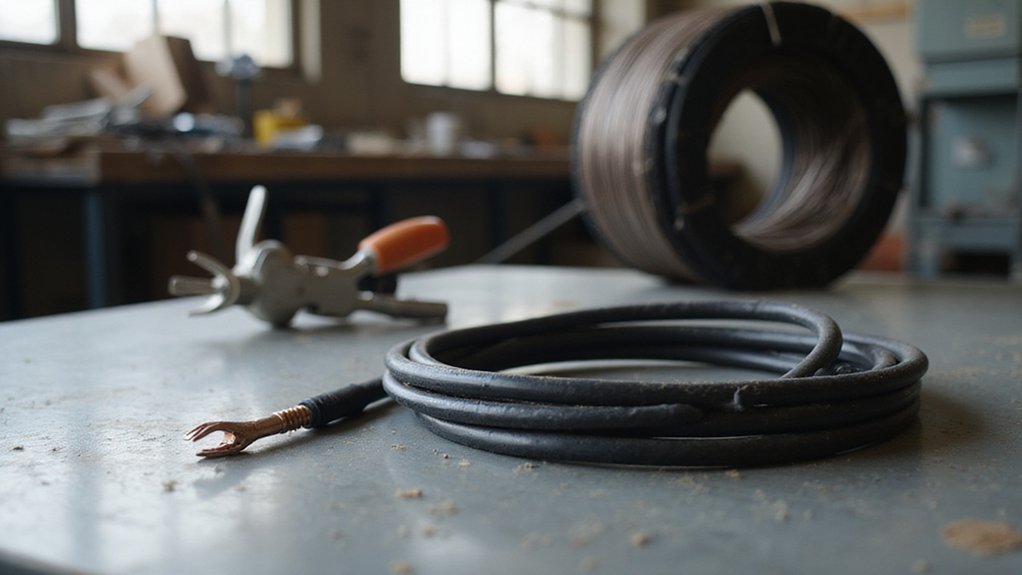
You need to match your welding leads to your machine’s amp rating and duty cycle, or you’ll risk overheating and poor performance. The cable gauge and length directly impact voltage drop, so a longer run demands thicker copper to maintain a stable arc. Also, don’t overlook connector compatibility and insulation durability, as cheap rubber jackets crack fast under shop abuse.
Amp Rating & Duty Cycle
When you start matching leads to your stick welder, the amp rating is your first non-negotiable checkpoint. It tells you the maximum current those cables can safely carry. Push beyond that, and you’re asking for overheating, damaged insulation, or even a fire hazard. Your weld quality takes a hit too. And don’t forget the duty cycle. This isn’t just jargon. It shows how long a lead can work at a specific amperage before it needs a cool down period. For heavy duty tasks at 200A or 600A, you need high numbers for both; low rated leads will choke under that load. Choose compatible specs with your welder’s output, and you’ll get reliable, consistent performance without interruptions!
Cable Gauge & Length
The cable gauge and length of your welding leads directly shape how your stick welder performs. Thicker gauges, like 2-AWG or 1/0, handle higher amperage with less voltage drop, so you get a steadier arc without wasted heat. Longer cables, meanwhile, add resistance; that’s fine for a 25-foot run, but stretch to 50 or 100 feet and you’ll notice weaker performance, especially at lower settings. Match the length to your actual workspace, not your fantasy one. A bulky 50-footer in a cramped garage is just a trip hazard. Heavier gauge cables also last longer under high-amperage abuse, so don’t cheap out there. Check your welder’s rated amperage, then pick a gauge that exceeds it. That combo keeps your arc hot, your leads cool, and your joints solid. It’s simple physics, but it pays off every bead.
Connector Compatibility
Since your welding machine won’t do you much good if you can’t plug into it, connector compatibility is where the rubber really meets the road. You need to match the lead’s connector to your welder’s receptacle, whether that’s a Dinse 10-25 or an LC-40 style. Double-check the current rating; it must meet or exceed your machine’s max amperage, otherwise you’re asking for trouble.
Also, verify the pin configuration and size. A loose fit creates resistance, and resistance creates heat, which is never good. Look for connectors built from solid brass or copper with corrosion-resistant plating; they’ll handle high-current transfer without degrading. And make sure the locking mechanism feels secure. A poor connection will arc, sputter, and waste your time. Get this right, and you’ll have a solid, dependable setup every single weld.
Electrode Size Range
Two key things to nail down before you pick a lead set: the electrode sizes you’ll actually run and the amperage they demand. Most stick work tops out at 1/4 inch rods, so confirm your leads support that maximum without breaking a sweat. Check that your electrode holder’s jaw clamps snugly around the rod’s diameter, too, because a loose grip leads to frustrating arcs and wasted metal.
Match the lead’s amp rating to that electrode size, or you’ll risk overheating and premature failure. Verify cable and connector compatibility so every link stays secure and reliable under load. And don’t forget flexibility and length, since bigger rods often mean tighter, trickier positions. You’ll want a lead that bends easily and reaches comfortably, not one that fights you mid-weld. Get these basics right, and you’re set for smooth, consistent beads.
Insulation & Durability
Your welding lead’s insulation is its first line of defense against a whole host of shop floor hazards. You want a material like EPDM rubber or TPE, as it resists cuts, tears, and chemical splashes. Thicker insulation handles high heat without melting, preventing dangerous electrical shorts.
Look for heavy-duty builds that shrug off ozone, sunlight, and moisture. This matters if you’re working outdoors or in harsh environments, because it guarantees long-term performance. Proper insulation also reduces your shock risk by keeping high currents isolated.
To get the most durability, pick a lead with impact and flame resistant properties. This extends its lifespan during demanding jobs. Here’s what to prioritize:
- EPDM or TPE insulation
- Thick, heat resistant build
- Weather and chemical resistant
- Impact and flame resistant
That combo keeps you safe and your gear working.
Handle & Jaw Design
When you’re stick welding, your handle and jaw design directly affect how steady your arc stays and how comfortable you feel hour after hour. A secure grip isn’t a luxury; it’s your first defense against electrode slippage mid-weld. Look for ergonomic handles that mold to your palm, reducing fatigue so you can hold that tight angle without shaking. The jaws matter just as much. Heavy-duty, impact-resistant jaws chew through high current loads without warping, ensuring solid contact every time. You want a spring-loaded or locking mechanism that snaps the rod in place, no fussing, no dropping. And don’t sleep on adjustable, multi-position jaws. They let you flip angles for tight spots or overhead work, keeping your hands clear of the heat and your weld cleaner. That’s control you can feel.
Voltage Rating
A steady handle and jaw setup is only half the battle. Voltage rating is your safety net, plain and simple. That number tells you the maximum voltage your lead can handle before the insulation breaks down, causing arcing or outright electrical failure.
First, check your welder’s maximum output voltage. Match it with leads rated at 600 volts, which covers nearly all stick welding scenarios. But if you’re running specialized or high-voltage equipment, you need higher ratings. Don’t gamble here.
Using underrated leads invites dangerous insulation meltdowns. Always verify that the rating on the jacket meets or exceeds your machine’s specs. It’s a quick check that keeps you alive and your weld clean. For everyday stick work, 600V leads are your reliable workhorse, no excuses.