If you’re building a CNC plasma table, the torch you choose can make or break your cuts. You need reliable, non-HF technology, dual voltage support, and clean arc start signals. And that’s exactly what these ten machines deliver. Let’s walk through the top contenders that actually justify the investment, starting with the powerful ANDELI 65 Amp.
ANDELI 65 Amp Plasma Cutter [CNC Enabled][ Non-HF],1.06″ Max Cut
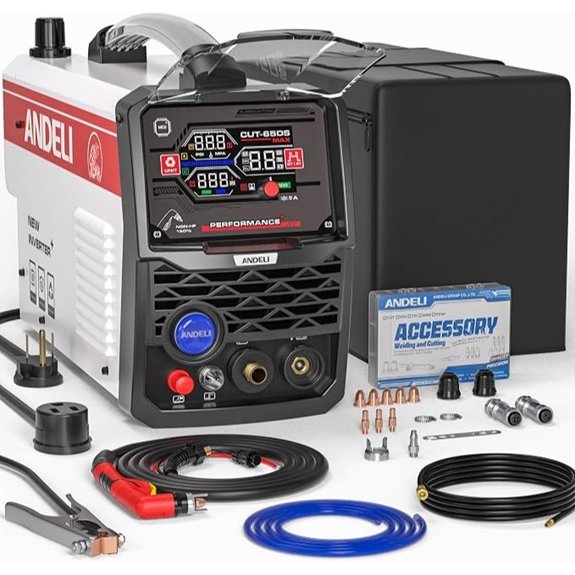
If you’re building a CNC table and need a plasma cutter that can handle automated precision without emptying your wallet, the ANDELI 65 Amp is your best bet, especially since it’s specifically designed to link up with your machine’s control system. You get both 2-pin arc-voltage and 4-pin signal-control ports, so connecting to your table’s brain is straightforward. It cuts up to 1.06 inches thick, and the 4.05-inch LED display shows you PSI, voltage, and current in real time. Plus, the intelligent ECO mode gives you 100% continuous cutting at 60% output for thin metal, saving energy. And with dual-voltage support (110V/220V), you’re ready for any shop setup. It’s a workhorse for automated jobs.
Eastwood Versa Cut 4X4 CNC Plasma Table with Cut 60
https://m.media-amazon.com/images/I/81d2WMO-WKL._AC_SX679_.jpg
This all-in-one system is perfect if you want a ready-to-cut CNC plasma solution without any hassle. You don’t need an external PC or extra software. Just load your files onto the integrated touch screen controller and start cutting. The rack-and-pinion drive delivers ±0.2 mm accuracy, while automatic torch height control keeps cuts consistent on metals up to 7/8 inch thick. Plus, the 33-gallon waterbed suppresses sparks and reduces warping.
Key benefits include:
- Dual voltage flexibility: Works on 120V or 240V.
- Pilot arc ignition: Cuts rusty or painted surfaces cleanly.
- Professional build: Locking casters and industrial materials ensure stability.
You get a 3 year warranty with lifetime support, so it’s a dependable investment for serious fabrication.
ARCCAPTAIN iControl CUT65 MP [CNC] Non-HF Plasma Cutter Machine, 65 Amp
https://m.media-amazon.com/images/I/71SLVlzCugL._AC_SX679_.jpg
You need a CNC ready plasma cutter that won’t mess with your electronics. The ARCCAPTAIN iControl CUT65 MP delivers exactly that with its non-HF blowback pilot arc, so no high-frequency interference will corrupt your table’s controller. It’s built for automation, featuring pre-installed ARC OK and THC signal outputs right out of the box. You’ll slice through rusty, painted, or expanded metal up to 32mm thick, and it even handles gouging and rust removal. The smart app lets you adjust current and monitor air pressure remotely, while the LED display alerts you to pressure issues before they ruin your cut. Safety protections shut things down automatically on over-voltage, over-current, or overheating. Lightweight at 20.6 pounds, it’s portable yet durable with a three-year warranty. Grab it for your CNC build and you’re set.
LTP8050CNC 80A CNC Drag-Cut Blowback Plasma Cutter 220V
https://m.media-amazon.com/images/I/81ZaH0yK2sL._AC_SX679_.jpg
The LTP8050CNC is your best bet if you need a heavy duty 80 amp plasma cutter that integrates seamlessly with a CNC table. It powers through 25mm steel cleanly and severs up to 38mm, perfect for structural steel, trailer frames, or heavy farm implements. Its non-HF blowback ignition fires instantly without zapping your CNC controller or laptop. For manual work, drag-cut torch lets you trace layouts by hand. Setup takes one minute with app-style LED controls. You fine-tune Pilot-Arc duration from 6 to 15 seconds and Post-Flow from 2 to 10 seconds. An air pressure alert keeps you honest, requiring clean dry air at 80 PSI. Pre-installed THC and ARC OK ports connect directly to your gantry. It includes an 18-foot torch, two nozzles, and two electrodes.
And here’s a quick checklist for CNC hookup:
- Use the 2-pin and 5-pin CNC connectors provided
- Set air pressure to 80 PSI
- Adjust Pilot-Arc timing on the front panel
The 30-pound unit runs on 220V and carries a 30-day return policy. You get industrial power without electronic interference, making it a solid buy for automated cutting.
Eastwood Versa-Cut 2’X2′ CNC Plasma Table with 40A Cutter
https://m.media-amazon.com/images/I/71OidpCR1KL._AC_SX679_.jpg
For hobbyists and small shop owners who want a complete, turnkey CNC plasma system without the hassle of piecing together components, the Eastwood Versa-Cut 2’X2′ CNC Plasma Table with 40A Cutter is your best bet. You get a dedicated CNC controller with an intuitive LCD display, so no external computer is needed. It even comes preloaded with standard shapes, and you can load custom designs via the built-in USB port. The 40A cutter handles steel, stainless, and aluminum up to 1/4 inch thick, with dual voltage operation (120V or 240V). Cutting precision lands within ±0.5mm. And you’ll appreciate the lifetime technical support and one-year warranty.
Eastwood Versa-Cut 4×4 CNC Plasma Table with Cutter
https://m.media-amazon.com/images/I/61LW9C4KgQL._AC_SX679_.jpg
Eastwood’s Versa-Cut 4×4 is your best bet if you want professional-grade results without the professional price tag. This all-in-one system gives you a massive 49” x 43” cut area, so you can handle full sheets straight from the mill. The intuitive LCD controller works without a PC, just plug in a USB with your designs from Fusion 360 or use pre-loaded shapes. It cuts up to 3/8” steel with ±0.5mm accuracy, and the dual-voltage 120V/240V setup means you can run it almost anywhere.
- Key specs you’ll love: 40A torch, 49.2” X-axis, and a 450 lb waterbed capacity for heavy workpieces.
- Support matters, and Eastwood backs it with lifetime technical help and a solid warranty.
You’re getting precision and durability without the headache.
Bestarc CNC Plasma Cutter Machine, 80A IGBT 110V/220V Blow Back Pilot Arc
https://m.media-amazon.com/images/I/71q2AD2bCSL._AC_SX679_.jpg
If you’re integrating a plasma cutter into a CNC table build, the Bestarc CNC Plasma Cutter Machine stands out for its dual voltage 110V/220V capability and blowback pilot arc.
This 80A IGBT unit delivers clean cuts up to 5/8 inch at 110V and a full 1.57 inches at 220V. The non-HF pilot arc design means zero electromagnetic interference with your CNC controller. It even cuts through painted or rusty surfaces without contact, saving your consumables.
You’ll appreciate the built-in air sensor with a front panel pressure display. Adjust your airflow manually using the regulator. The 2T/4T automatic modes simplify operation, and you can set post time between 3 and 15 seconds to extend torch life. Setup takes minutes, thanks to the straightforward CNC 5-pin interface.
Eastwood Versa-Cut 2×2 CNC Plasma Table
https://m.media-amazon.com/images/I/71xbgxvQbcL._AC_SX679_.jpg
This table’s a sweet spot for hobbyists wanting pro results without a huge footprint. You get a compact 24” x 24” cutting area, perfect for custom brackets or signage. The integrated touchscreen controller eliminates external computers. Just load your DXF files via USB or pick from fifty pre-loaded shapes. Automatic torch height control keeps cuts precise, while the 10-gallon waterbed reduces warping and sparks.
The steel frame handles up to 200 lbs of workload. You’ll need their Versa-Cut 40 plasma cutter (sold separately), but the system runs on standard 120V. Eastwood backs it with a one-year warranty. It’s a turnkey solution for precise, safe, and professional-grade results.
SILATU 85A CNC Plasma Cutter Machine, Non-HF Blowback Pilot Arc, 110V/220V
https://m.media-amazon.com/images/I/71+TQs5zxKL._AC_SX679_.jpg
SILATU’s 85A CNC plasma cutter is the best choice for budget minded builders who want true CNC integration without sacrificing cut quality. You get two critical ports: a 2-pin for arc voltage output and a 5-pin for signal control, so hooking it up to your table is straightforward. It automatically detects voltage, letting you run on 110V or 220V. On 220V at 85A, you’ll cut up to 35mm thick steel, stainless, or aluminum. The non-HF blowback pilot arc means no radio interference with your electronics.
Key features for your build:
- Air pressure sensor with manual rear regulator.
- Adjustable post-flow cooling (3-15 seconds) extends torch life.
- Modes: 2T for semi-auto, 4T for hands free, plus a mesh cutting mode.
- Weighs just 23.2 pounds, includes a 16ft torch and 10ft ground clamp.
But remember, you’ll need an external compressor set to 70 PSI and 250 L/min. And for best CNC cuts, grab an optional straight torch like the PTM80.
LTP6300DCNC 63A CNC Drag-Cut Blowback Plasma Cutter 110V/220V
https://m.media-amazon.com/images/I/81tm-9-FFmL._AC_SX679_.jpg
For CNC table builders chasing both manual flexibility and automated precision, the LTP6300DCNC stands out as your dual-purpose workhorse. It auto-senses 110V or 220V, so you just plug and cut. You’ll appreciate the blowback pilot arc: no high-frequency interference, keeping your CNC controller safe.
Here’s what you get:
- Power: 63A output cuts 3/4 inch steel cleanly, severs 1 inch. Minimal slag saves cleanup time.
- Drag Cutting: Rest the torch tip on sheet metal. No standoff fatigue. Great for custom HVAC, metal art, or hand tracing.
- CNC Ready: Rear ports deliver ARC OK and THC signals. You get precise, repeatable cuts on your table.
Requires 70 PSI compressed air at 4.0 SCFM. Use genuine LOTOS DC6309 parts. Weighs just 21.5 pounds for easy setup. A 4.3 star rating confirms its value. It’s the cutter you grab for every job.
Factors to Consider When Choosing a Plasma Cutter for CNC Table
Before you commit to a cutter for your table, you’ve got to match the machine’s brain to your CNC controller’s signals, or you’ll get nothing but misfires and frustration. Then, think about the amperage you realistically need for your material thickness, along with the voltage input your shop can supply, because a 110V unit won’t handle heavy plate as well as a 220V model. And don’t overlook the duty cycle for long cuts or check for a torch height control port; these features determine whether you’ll be stopping to cool down or manually tweaking the torch every few minutes.
CNC Signal Compatibility
When you’re pairing a plasma cutter with a CNC table, signal compatibility is the backbone of a smooth, automated workflow. You’ve got to verify the cutter has compatible ports, like 2-pin arc voltage and 5-pin signal control, for seamless integration. Confirm it supports essential CNC modes, such as 2T, 4T, or integrated THC signals. Without proper ARC OK and torch height control outputs, your CNC controller won’t communicate reliably.
Check that interface protocols match your table’s input requirements. Voltage levels and connector types must align, or you’ll face frustrating communication failures mid cut. Look for these specifics in the manual:
- Arc voltage connection (2 pin)
- Signal control (5 pin)
- THC output support
- Proper voltage and connector standards
That’s the recipe for a cutter that talks perfectly with your table, no guesswork needed!
Amperage Versus Thickness
Signal compatibility lays the groundwork for automation, but amperage is what actually decides how thick a piece of metal your CNC table can chew through. Think of it as raw cutting muscle. Higher amperage lets you tackle materials over half an inch thick, with some models efficiently slicing through up to 1.5 inches. For thinner sheet metal under a quarter inch, though, you need lower settings. They give you better control and cleaner cuts. The rule is simple: more amperage means more penetration. Skimp on it, and you’ll face incomplete cuts, excessive slag, or even damage your gear. So, match your cutter’s rating to your thickest job. Don’t guess. Check the specs. Your CNC table deserves that precision.
Voltage Input Flexibility
While amperage decides how thick you can cut, voltage input flexibility is what makes your plasma cutter truly versatile in different workspaces. You’ll want a model with dual voltage capability like 110V/220V, so it plays nice with whatever power you’ve got at home or on a job site. Look for automatic voltage detection too; it simplifies setup and spares you from manual dial fiddling.
A cutter that handles variable input ranges, like 120V and 240V, saves you time and cash since you won’t need clunky converters or adapters. That means more portability, less hassle when you roll into a new shop. To maximize this flexibility, verify your machine supports common voltages before you buy. It’s a small detail that pays off big when you’re setting up in different electrical environments, keeping your CNC table running smoothly wherever you go.
Duty Cycle Demands
Voltage input flexibility gets your machine powered up, but duty cycle demands keep it running. Think of duty cycle as the percentage of a 10-minute window you can cut before overheating forces a cooldown. For CNC work, where the torch often runs unattended, you want 60% or higher. That’s six straight minutes at full amperage, then four minutes of rest. Skimp here, and you’ll watch your productivity stall while the machine sulks.
Check the rating at your typical cutting current, not just the max. A 60A unit rated at 60% duty cycle at 60A gives you that 6-minute run. For repetitive, automated cuts, prioritize a higher cycle. It’s the difference between a steady workflow and constant babysitting. Your table doesn’t care about your impatience, so let the duty cycle do the heavy lifting.
Torch Height Control Ports
What’s the point of a plasma cutter that can’t talk to your CNC table? You need torch height control (THC) ports for real time height adjustment during cuts. These ports automate arc voltage regulation, keeping that torch gap perfect for consistent quality.
Look for a signal output for arc voltage and a separate connection for height control. That pairing lets your CNC system handle precise vertical positioning automatically. Check compatibility with your specific controller. Some units offer 2-pin or 5-pin connectors, so match those up.
Without proper THC ports, you’re stuck manually adjusting mid cut. That kills productivity and quality. So, verify your plasma cutter has the right ports, designed to integrate seamlessly. You’ll get cleaner edges, longer consumable life, and fewer headaches. It’s a must have for any serious CNC table build.
Air Pressure Requirements
And once you’ve got your torch height control ports squared away, there’s another key factor you can’t afford to overlook: air pressure requirements. You need a steady supply around 70 PSI, and that’s non-negotiable. Drop below that, and you’ll face incomplete cuts, wobbly arc stability, or worse, torch damage. Most units come with an integrated pressure display, so you can dial it in on the fly. But don’t forget your external compressor; you want a flow rate near 4.0 to 4.5 SCFM. That keeps things efficient, prevents overheating, and stretches consumable life. Consistent pressure also means cleaner edges and fewer hiccups mid-cut. So, check those specs before you commit. It’s a simple setting, but it makes all the difference between smooth sailing and constant frustration.
Non-HF Arc Stability
One major factor you’ll want to nail down when choosing a plasma cutter for your CNC table is arc stability, especially with non-HF models. Non-HF cutters use blowback pilot arc technology, which slashes electromagnetic interference. That means no high-frequency signals messing with your CNC’s sensitive control electronics. Arc stability here depends on consistent air pressure and controlled ignition.
You need a steady power supply and regulated airflow to keep that arc smooth. Otherwise, when cutting intricate patterns or thin, painted surfaces, you’ll get jagged edges instead of clean lines. Proper setup boosts stability big time.
So, dial in your air pressure and power, and you’ll see the difference:
- Reduced electrical noise.
- Precision cuts, even on fussy materials.
- No more sputtering arcs ruining your job.
Go with a non-HF model for CNC peace of mind.