You might think you need a massive, expensive machine to get real arc power, but that’s a myth. Modern inverters deliver serious punch in lightweight, portable packages. I’m breaking down the top 10 models that balance raw amperage with smart features, so you can weld confidently from thin sheet metal to heavy plate. Let’s find your perfect match.
BESTMIG 135A MIG Welder 3-in-1 with Helmet & Gloves
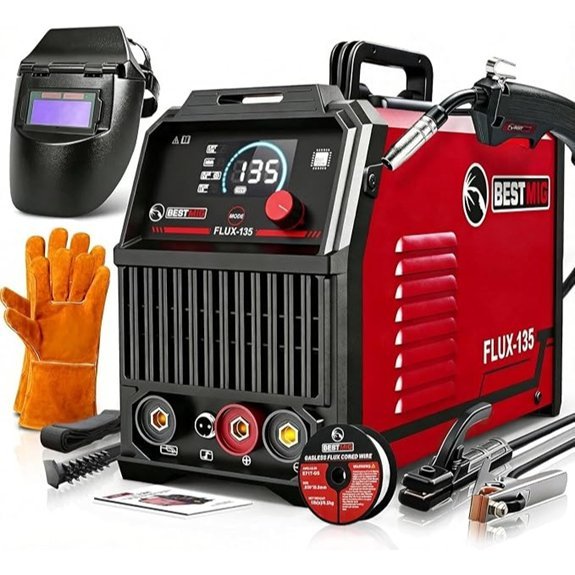
The kit includes an auto-darkening helmet, gloves, and flux-core wire. Just load, connect, and go. Weighing only 10.7 pounds, it’s easy to move around your garage. For the price, you’re getting serious versatility without breaking the bank.
250Amp ARC Stick Welder 110V/220V Dual Voltage
https://m.media-amazon.com/images/I/71YLp0P5UUL._AC_SX679_.jpg
Looking for a welder that can follow you from your garage to a jobsite without missing a beat? This 250Amp ARC Stick Welder automatically switches between 110V and 220V, so you plug into whatever’s available. At just 8.58 pounds with a built-in handle, you’ll cart it anywhere for farm repairs or mobile gigs.
Its true 250A output lets you weld stainless steel, carbon steel, cast iron, and sheet metal. You’ll get deep penetration with E6010, E6013, or E7018 rods.
The IGBT inverter keeps your arc stable, even with flaky input voltage. Hot Start fires up instantly, Arc Force drives penetration deeper, and Anti-Stick saves you from rookie mistakes. A bright LED display shows your current without interrupting work. Complete kit includes gloves and 10 rods.
HONE Stick Welder 110V, 205Amp with Lift TIG
https://m.media-amazon.com/images/I/71DzhKBpCaL._AC_SX679_.jpg
If you’re a weekend warrior or a DIY homeowner who needs one machine that handles both stick and TIG welding without breaking the bank, the HONE Stick Welder 110V is your best bet. It’s a compact 4.4-pound powerhouse with adjustability from 20 to 205 amps, so you can weld thin 0.05-inch sheet metal or thicker 0.22-inch steel. Plus, the Lift TIG mode lets you start arcs without scratching tungsten, which is a huge win for cleaner work. It comes with 25 rods, gloves, and a helmet, so you’re ready to weld right out of the box. And with VRD safety and IGBT tech, it’s stable on fluctuating voltage, making it perfect for garage projects or fence repairs.
ARCCAPTAIN 165A MIG Welder 110V 220V 4-in-1 Gasless Gas MIG Stick Lift TIG
https://m.media-amazon.com/images/I/71M-txzs6DL._AC_SX679_.jpg
For DIYers and home garage tinkerers, the ARCCAPTAIN 165A MIG Welder is your best bet. Its 4 in 1 capability handles gasless flux core, gas MIG, stick, and lift TIG (you’ll need the WP-17V torch separately). You get dual voltage 110V or 220V, just verify the screen’s off and fan stops before switching.
The upgraded MCU and IGBT tech let you dial in precise settings. The large LED display shows everything clearly, even with your helmet down. With 165A output and 60% duty cycle, it welds mild steel up to 3/16 inches. An enhanced cooling fan boosts heat dissipation by 30%, supporting longer jobs.
Weighing only 12.8 pounds, it’s easy to carry with the handle and shoulder strap. You get a 6.5ft MIG torch, 10ft ground clamp, and flux cored wire. It only takes 2 pound spools, perfect for quick repairs. A 2 year warranty backs you up.
Lincoln Electric Weld-Pak 225i Stick Welder, Dual Voltage
https://m.media-amazon.com/images/I/81+MRXykaHL._SX522_.jpg
The Lincoln Electric Weld-Pak 225i is your best pick if you need a dual voltage stick welder that travels as hard as you do. You’ll love its lightweight design at just 20 pounds, complete with shoulder straps and a built-in toolbox top for stashing cables. Plug into either 120V or 230V, and you’re ready to weld from 10 to 225 amps DC. It handles mild steel stick electrodes from 5/64 to 5/32, delivering smooth, stable arcs on 12-gauge sheet metal up to 5/16 steel in a single pass.
Plus, you get a solid 30% duty cycle at 225 amps on 230VAC. The simple control display makes adjustments a breeze, and the accessory kit includes 13-foot cables, a 230V plug, and a 5-15P adapter. Want to TIG? Just add the torch and use Touch Start. It’s your compact powerhouse for maintenance or fabrication!
YESWELDER 205Amp Stick Welder Digital Inverter IGBT ARC Welding Machine
https://m.media-amazon.com/images/I/711WAf-K8rL._AC_SX679_.jpg
You’re hunting for a stick welder that actually adapts to your power situation without dragging you down. This YESWELDER shines with dual voltage support (110V/220V) and a 205-amp output. Its IGBT tech delivers a stable arc, while Hot Start and Arc Force features let you dial in 1-10 levels for cleaner starts and less stick. Weighing just 8.4 lbs, it’s a breeze to move from garage to farm. The large LED display shows current and mode, and the knob adjusts even with gloves on. Safety includes overcurrent and thermal protection. Plus, it handles 6010, 6011, 6013, and 7018 rods with ease.
SOARFLY Stick Welder, 110V/220V Dual Voltage Welding Machine(Orange)
https://m.media-amazon.com/images/I/71r8x11qurL._AC_SX679_PIbundle-10,TopRight,0,0_SH20_.jpg
IGBT inverter tech makes the SOARFLY Stick Welder a smart pick if you need flexible power on the go. You get dual voltage capability (110V and 220V), though you’ll need an adapter for 220V. This 250-amp machine handles electrodes from 2.5mm to 3.2mm, so you can weld stainless steel, carbon steel, or cast iron. It supports rods like E6010 and E7018, too.
You’ll love the large LED display showing real-time current. Hot start and anti-stick features make arc initiation a breeze. Safety protections cover overheating and overcurrent, plus the cooling fan keeps things running smoothly.
Weighing just 3.7kg with a built-in handle? That’s easy portability. Your kit includes 10 welding rods, gloves, and a brush. Perfect for garage projects or outdoor repairs.
ARCCAPTAIN Stick Welder, 200A ARC/Lift TIG Welding Machine, 110V/220V
https://m.media-amazon.com/images/I/71owj+LHZxL._AC_SX679_.jpg
Weighing just 11 pounds, this ARCCAPTAIN Stick Welder is your go to for anyone who needs serious welding power without a garage full of space. Its intelligent LED display gives you clear readings, so you don’t have to lift your helmet mid weld. You get advanced MCU control with IGBT tech, delivering stable arcs automatically. It matches current and voltage based on your electrode size, perfect for beginners. You can adjust hot start, arc force, and anti stick features. Dual voltage operation (110V/220V) makes it versatile. Safety certifications cover overcurrent, overvoltage, and overheating. The package includes a 10 foot electrode holder, ground clamp, shoulder strap, brush, and hammer. Two year warranty backs it all up.
Hpoouo 200Amp 20PCS Rods Stick Welder, Super MINI Portable Welding Machine
https://m.media-amazon.com/images/I/71luOySu1sL._AC_SX679_.jpg
This mini welder is a perfect entry-level pick for weekend DIYers. It runs on standard 110V and adjusts from 20 to 200 amps, so you can tackle thin sheet metal or thicker stock. The digital IGBT inverter gives you stable arc performance with hot start and anti-stick features, meaning no more frustrating rod grabbing.
You get 20 rods in the kit plus gloves and two chip hammers. At just 3.7 pounds and compact dimensions, you can toss it in your truck for farm repairs or rooftop work. It handles E6013, E7018, and stainless rods up to 1/8 inch. And built in protections keep it running safely.
YESWELDER 135A MIG Welder, 110V Flux Core Gasless MIG/Lift TIG/Stick 3-in-1
https://m.media-amazon.com/images/I/71snNJNtAUL._AC_SX679_.jpg
Looking for a welder that won’t chain you to a gas tank or a heavy workshop setup? This YESWELDER 135A is your ticket. It’s a 3 in 1 machine, handling gasless flux core MIG, lift TIG (you’ll need the torch), and stick welding. Perfect for outdoor jobs, wind won’t bother you. You’ll love the synergic control: it automatically matches voltage to wire speed for beginners, but you can micro adjust ±3V for auto body fine tuning. The 11.4 pound body with a handle lets you take it anywhere. It’s tough, too, with over current, overload, and overheating protection.
Factors to Consider When Choosing an Inverter for Welder
You’ll need to understand a few key specs before you pick your inverter: power ratings, duty cycle, input voltage flexibility, inverter technology types, and portability and weight. Each one directly affects how well the machine handles your specific projects, from light home repairs to heavy shop work. Get these right, and you’ll avoid overheating, power shortages, and a backache from lugging a brick around!
Power Ratings Explained
When you look at power ratings for welders, amperes (amps) are the main number to focus on. They tell you the maximum welding current the inverter can deliver, which directly dictates how thick the metal you can weld. For thicker materials, you’ll want a higher rating, simple as that. But don’t confuse input voltage with output power. An inverter with dual voltage support gives you flexibility for different power sources, so you’re not stuck if only a 120V outlet is nearby.
Here’s a quick breakdown of what to check:
- Amperage range: This decides your material thickness capability.
- Duty cycle: We’ll get to that next, but know it’s how long you can weld without overheating.
- Dual voltage: A lifesaver for switching between job sites.
Understand these details, and you’ll confidently pick an inverter that handles your specific tasks without surprises.
Duty Cycle Matters
Duty cycle is the next big thing to wrap your head around, because it tells you how hard you can push your inverter without it throwing in the towel. It’s a simple percentage: how long you can weld continuously within a 10-minute window before the machine needs a breather. For instance, a 60% duty cycle at 150 amps lets you weld for a solid 6 minutes, then demands a 4-minute cool down.
You need this number to match your tasks. Tackling a big project? Hunt for a higher duty cycle, like 80% or more, so you’re not constantly waiting. Choose wrong, and you risk overheating your inverter mid-weld, which is a real buzzkill. So check those ratings before you click buy. It’s the difference between finishing strong and calling it quits early.
Input Voltage Flexibility
Another factor to take into account is input voltage flexibility, which can make or break your setup depending on where you’re working. You don’t want to haul a 220V machine to a job site with only 110V outlets. Choose a dual voltage inverter (110V/220V). It’ll handle both domestic and industrial settings without extra gear.
Automatic voltage switching keeps your arc consistent despite fluctuations or different electrical standards. Plus, a wide input voltage range protects your machine from power surges and spikes. No need for adapters or converters.
Here’s what you gain:
- Versatility: Use it at home or on the job.
- Protection: Survives dirty power.
- Efficiency: Less setup hassle, more welding.
Inverter Technology Types
Now let’s talk about the brain of your inverter welder: the inverter technology type. You’ll mostly see IGBT or MOSFET guts here, and they’re not just marketing jargon. IGBT-based inverters are your heavy lifters. They switch fast, waste less power, and handle high-amperage jobs without breaking a sweat. That makes them perfect for thick metal and industrial work. On the flip side, MOSFET inverters run at higher frequencies, giving you a smoother arc and finer control, ideal for lighter, more delicate tasks. Don’t overlook digital controls either; they use microcontrollers to let you tweak parameters precisely, so you can dial in settings for specific metals or thicknesses. Your choice here directly affects arc stability, energy draw, and how well the machine suits your typical workload. So, match the tech to the thickness you’ll weld, and you’re already ahead. It’s that simple!
Portability and Weight
When you’re hauling your gear up a ladder or across a job site, a few pounds can make all the difference. That’s why you’ll love lightweight inverter welders, many weighing under 10 pounds. They’re built for mobility, often with integrated handles or shoulder straps that let you move freely. Heavier units offer more stability and advanced features, but they’ll anchor you to one spot. So, ask yourself: do you need raw power on a workshop floor, or the freedom to weld anywhere? For outdoor or on-site tasks, lighter models are your clear winner. But don’t sacrifice too much functionality for weight. Balance your portability needs with the amperage and duty cycle your projects demand. A well-chosen inverter should feel like an extension of your arm, not a burden on your back.
Safety Protection Features
Safety protection features are your inverter’s built-in bodyguard, and you don’t want to omit them. They shield you and your gear from trouble, so let’s break down what to look for.
First, you need over-current, over-voltage, and overload protections. These automatically kick in when things get sketchy, preventing damage mid-weld. And thermal overload protection is a lifesaver it stops overheating before your inverter burns out, keeping performance steady for years.
Voltage fluctuation compensation? That guarantees stable operation even when your shop’s power supply is shaky, so you won’t face sudden shutdowns. Finally, check for safety certifications like TÜV, ANSI, or CE. They mean the unit meets recognized standards, giving you peace of mind. Automatic shutdown functions also trigger when thresholds are exceeded, safeguarding both you and the equipment. Don’t overlook these features they’re non-negotiable for real arc power!